


Description
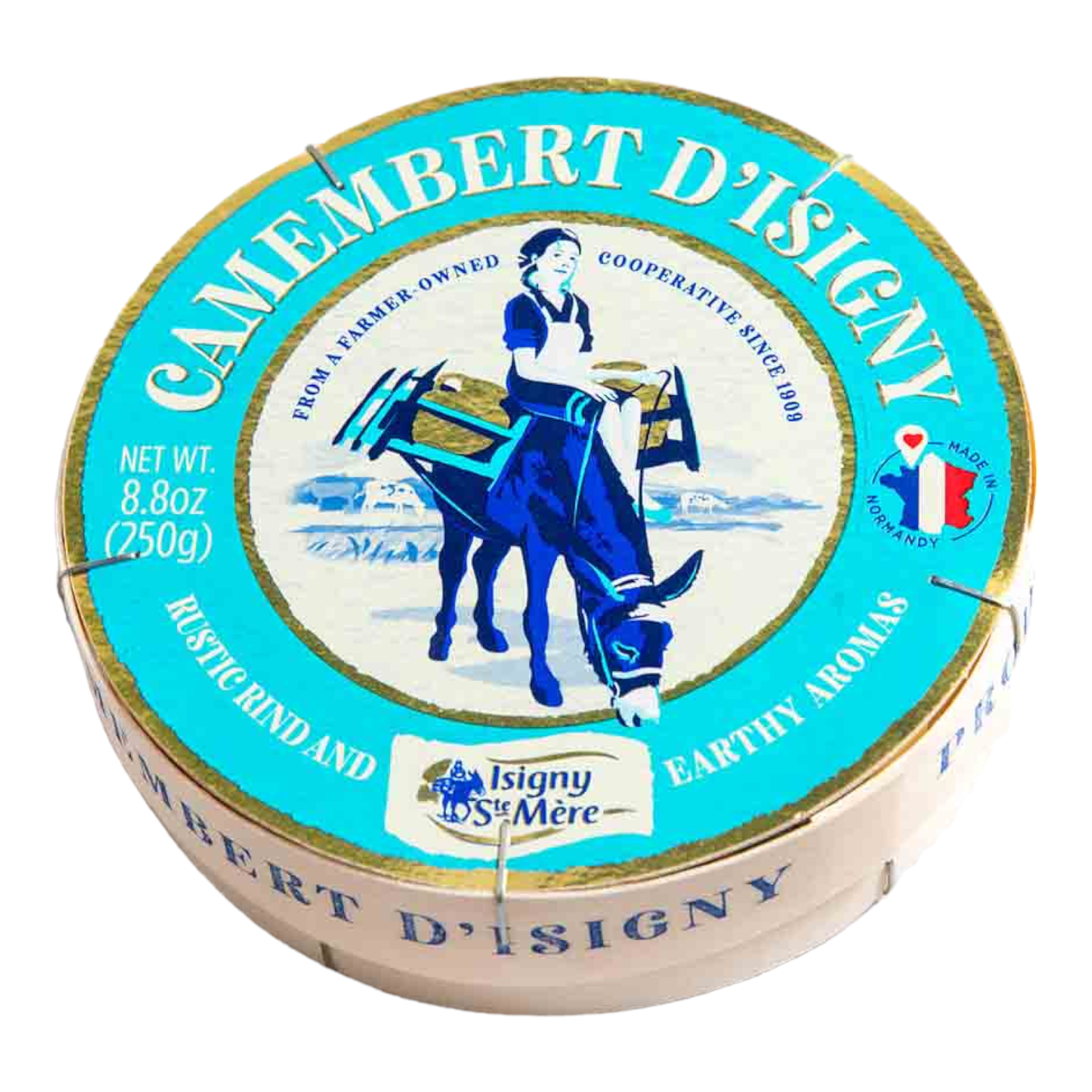
Our Camembert comes from the Normandy terroir, in the heart of the Cotentin and Bessin Marshes Regional Natural Park, and is made exclusively from the finest Normandy milk, which is exceptionally rich in fat, protein and vitamins.
THE SENSORY PROPERTIES OF CAMEMBERT
The milk from the farms of the Isigny Sainte-Mère Cooperative contains naturally occurring lactic flora that are unique and typical of the Isigny Sainte-Mère terroir.
They are present in the Camembert cheeses, enabling connoisseurs to recognise the Cooperative’s products from other Camemberts by their taste alone.
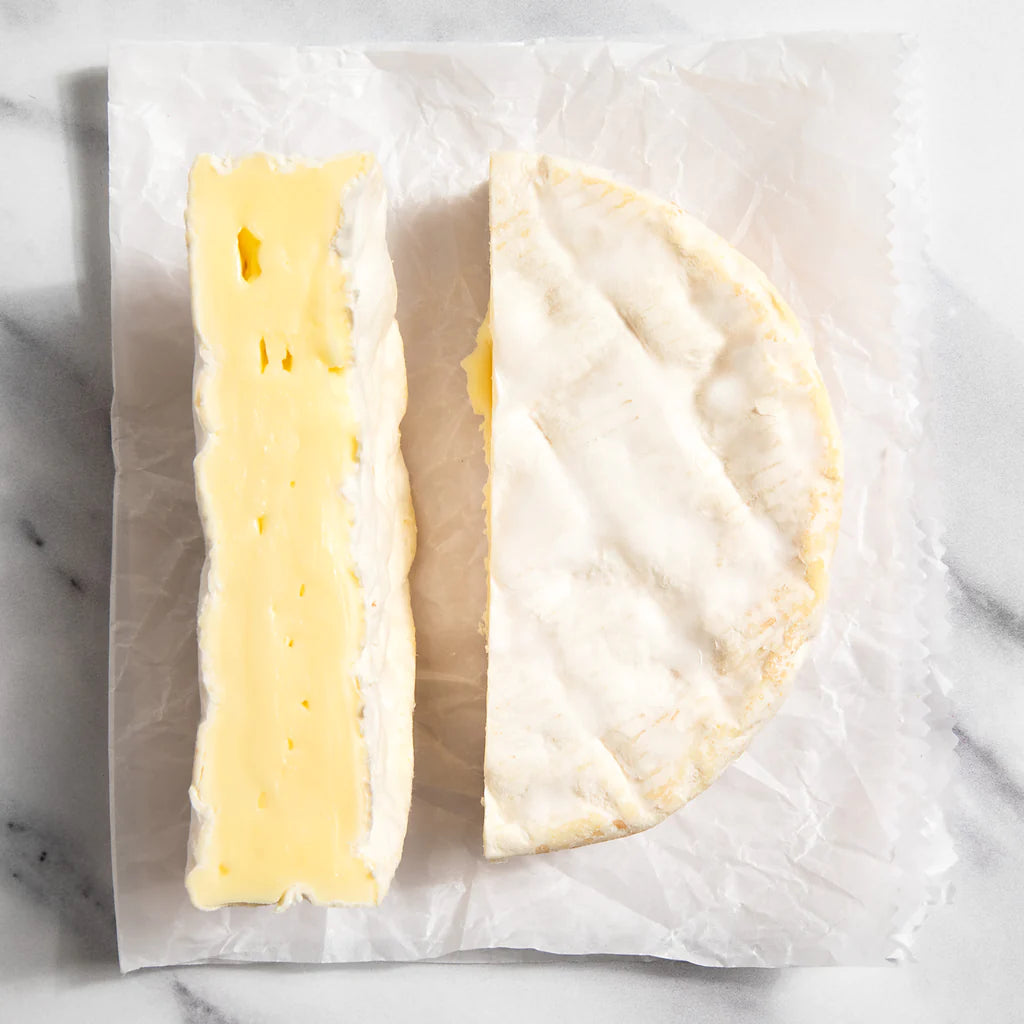
Isigny Camembert has a thin rind with surface mould forming a white felt-like coating.
The cheese is ivory to light yellow in colour, when fully ripened. It is smooth and soft.
The flavour of this cheese is slightly salty and its taste is milky and mild at first, becoming stronger and more fruity as it ages.
----
We pay particular attention to each stage of production, to ensure that our Camembert cheeses are of impeccable consistency and quality.
The milk is picked up every 48 hours from our producers, then transported to collection tanks where we take an initial set of samples to ensure that it meets our quality requirements.
The milk is then seeded with lactic cultures and matured for 12 hours at a temperature of 12 to 15°C. This is done with our lactic cultures, which come exclusively from the Isigny terroir.
These fermenting agents give our Camembert cheeses their typical, distinctive taste, playing an essential role in expressing the Camembert’s “bouquet”.
The milk is poured into vats to which we then gradually add rennet to transform it into curds. These curds are then sliced, ladled and placed in moulds at intervals.
The Camembert cheeses will drain naturally for almost 18 hours.
The Camembert will then be salted, dried and they can begin their ripening process in our ripening rooms.
On day four of ripening, the Camemberts release a sweet smell of apples, a sign of great quality.
The cheeses are turned by hand on day five and separated from each other, as our Master Cheesemaker explains:
During their time in our ripening rooms, the cheeses bloom and develop a characteristic white rind (due to the penicillium that develops on the surface). After 12 days, they will be transferred to the maturing cellar and it will take another week of ripening before the first Camembert cheeses will be tasted.
In 1702, in his “Dictionnaire Universel Géographique et Historique”, published in 1708, Thomas Corneille described the big market held in Vimoutiers every Monday, where people brought excellent cheeses from the Camembert region.
At the time, “Camembert” was one of many cheeses from the Pays d’Auge, made in the 18th century by farmers and sold “en blanc” to ripeners.
According to a local legend, Camembert cheese was first produced in 1791 at the height of the French Revolution, from a transfer of skills in Vimoutiers in the south of the Pays d’Auge, between the Abbot Charles-Jean Bonvoust, a refractory priest, and his protector, Marie Harel, who was hiding him on her farm.
Camembert became famous in 1863, when Napoleon III inaugurated the railway line between Paris and Granville.
During a stopover in Surdon, Marie Harel’s grandson gave him a taste of this precious cheese. It is said that the Emperor asked her grandson for the name of the cheese, and when he didn’t know, the Emperor suggested the name Camembert. He then regularly ordered Camembert to serve at the Tuileries Palace.
In 1914, during the First World War, Camembert cheese was part of the wartime ration of French soldiers who ate it on the front line. All
the cheese dairies in Normandy prospered by making this cheese, which quickly became a symbol of the nation.
In 1932, the Isigny Cooperative began producing mould-ladled Camembert. The cheesemakers worked around large tables onto which iron moulds were placed, meticulously ladling out the precious curds from a typical Norman vat. The women then ripened and sorted the cheeses.